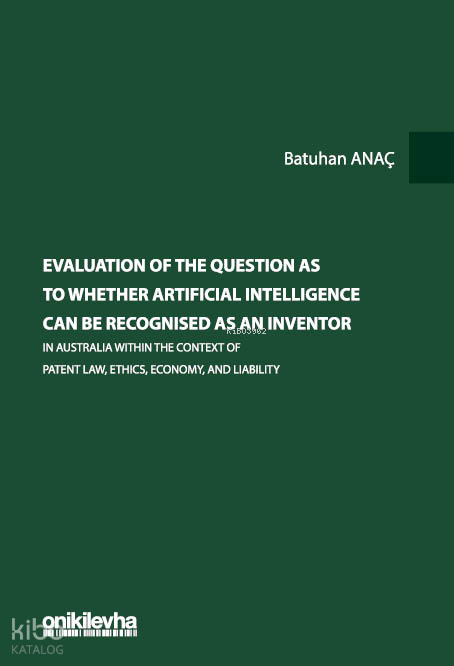
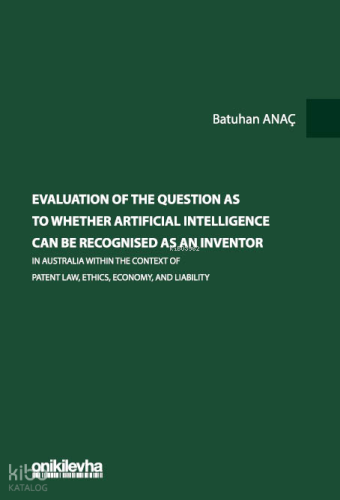
Evaluation Of The Question As To Whether Artificial Intelligence Can Be Recognised As An Inventor;In Australia Within The Context Of Patent Law, Ethics, Economy, And Liability
Boyut:
160-235-
Sayfa Sayısı:
39
Baskı:
1
Basım Tarihi:
2025-03-04
Kapak Türü:
Karton
Kağıt Türü:
1.Hamur
Dili:
İngilizce
Kategori:
%7
indirimli
95,00
88,35
Havale/EFT ile:
82,17
9786255930118
748138
https://www.sehadetkitap.com/urun/evaluation-of-the-question-as-to-whether-artificial-intelligence-can-be-recognised-as-an-inventor-in-australia-within-the-context-of-patent-law-ethics-economy-and-liability
Evaluation Of The Question As To Whether Artificial Intelligence Can Be Recognised As An Inventor;In Australia Within The Context Of Patent Law, Ethics, Economy, And Liability
88.35
As developing artificial intelligence technologies has influenced many fields, patent law has also taken its share. In recent years, the number of AI-generated inventions has risen significantly. This led to a discussion about recognising artificial intelligence as an inventor like human beings. While the debate highlights the role of technology in the invention process, it also challenges the limits of patent law. In this book, the debate of AI inventorship is examined with a milestone case called DABUS by analysing two opposing decisions in Australian jurisdiction under Australian patent legislation. However, recognising an artificial intelligence as an inventor and granting it a title is not only an issue concerning patent law but also ethics, economics, and liability. This book also addressed artificial intelligence's impact and shortcomings from the perspectives of tort law, economics, and ethics through an interdisciplinary approach.(ARKA KAPAKTAN)
TABLE OF CONTENTS
INTRODUCTION
CHAPTER 1
RECOGNISING ARTIFICIAL INTELLIGENCE AS INVENTOR
A. Introduction
B. Critics to Grounds for inventor AI
C. Concluding Remarks
CHAPTER 2
OTHER OBSTACLES ON THE WAY TO AI INVENTORSHIP
A. Introduction
B. Economic Considerations
1. Unemployment
2. New Tasks, New Jobs
3. Inequality
C. Ethical Considerations
1. Ethical Theories
2. Australian Practice
D. Liability Consideration
1. Negligence
2. Strict Liability / Product Liability
3. Solutions
CONCLUSION
BIBLIOGRAPHY
As developing artificial intelligence technologies has influenced many fields, patent law has also taken its share. In recent years, the number of AI-generated inventions has risen significantly. This led to a discussion about recognising artificial intelligence as an inventor like human beings. While the debate highlights the role of technology in the invention process, it also challenges the limits of patent law. In this book, the debate of AI inventorship is examined with a milestone case called DABUS by analysing two opposing decisions in Australian jurisdiction under Australian patent legislation. However, recognising an artificial intelligence as an inventor and granting it a title is not only an issue concerning patent law but also ethics, economics, and liability. This book also addressed artificial intelligence's impact and shortcomings from the perspectives of tort law, economics, and ethics through an interdisciplinary approach.(ARKA KAPAKTAN)
TABLE OF CONTENTS
INTRODUCTION
CHAPTER 1
RECOGNISING ARTIFICIAL INTELLIGENCE AS INVENTOR
A. Introduction
B. Critics to Grounds for inventor AI
C. Concluding Remarks
CHAPTER 2
OTHER OBSTACLES ON THE WAY TO AI INVENTORSHIP
A. Introduction
B. Economic Considerations
1. Unemployment
2. New Tasks, New Jobs
3. Inequality
C. Ethical Considerations
1. Ethical Theories
2. Australian Practice
D. Liability Consideration
1. Negligence
2. Strict Liability / Product Liability
3. Solutions
CONCLUSION
BIBLIOGRAPHY
Yorum yaz
Bu kitabı henüz kimse eleştirmemiş.
-
-%7
 Stokta yok
 -
-%7
Stokta yok%7İNDİRİM1.075,00 999,75
-
-%7
Stokta yok%7İNDİRİM1.250,00 1.162,50
-
-%7
Stokta yok%7İNDİRİM2.500,00 2.325,00
-
-%7
Stokta yok
-
-%7
Stokta yok%7İNDİRİM390,00 362,70
-
-%7
Stokta yok%7İNDİRİM600,00 558,00
-
-%7
Stokta yok
-
-%7
Stokta yok
-
-%7
Stokta yok%7İNDİRİM1.200,00 1.116,00